Silent Signage: How Manchester 2013's Lanyard Colours Sorted Delegates — and What 2026 Can Learn
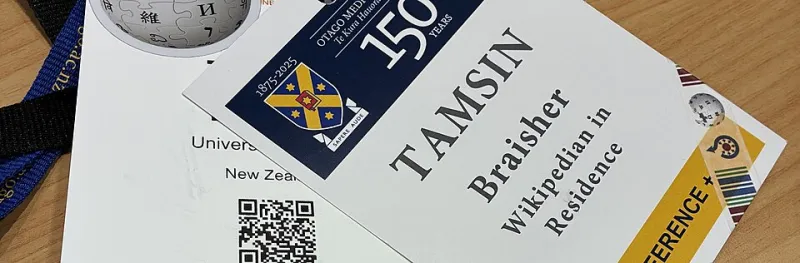
Photo: DrThneed, CC BY 4.0, via Wikimedia Commons
Few objects at an academic conference are as ubiquitous, or as quietly consequential, as the lanyard. It is the first item handed over at registration and the last thing many delegates remove at the end of the day. In the Manchester 2013 record held by this archive, lanyards and their attached badges survive in several forms: printed templates, colour specifications, registration lists and the briefings issued to student volunteers. Read together, these modest documents reveal a system of sorting that was never merely administrative. The badge told you where you could go, but it also told you — and everyone else — who you were.
The Colour of Access
Surviving template files from the Manchester meeting indicate that lanyard colours were not uniform. Different hues distinguished delegates, volunteers, organisers, exhibitors and day registrants. In themselves, these distinctions are practical: a steward needs to spot a colleague across a crowded foyer. But colour coding also creates a public language of belonging. A delegate who notices that the person beside them wears a different colour learns quickly that the conference is not a flat gathering of equals. The archive's registration lists, which record category alongside name, confirm that these categories were fixed at the point of registration and rarely revised. Once assigned, a colour followed a delegate through every room, every coffee break and every evening reception.
The Name Tag as Credential
The badge template required a name, an institution and a country. Title was optional but frequently supplied. In an international meeting, the institutional line did more than identify; it located the delegate within a hierarchy of prestige. A UK delegate from a large research-intensive university and an early-career researcher from a smaller institution might wear the same colour lanyard, but their badges said different things. The archive's volunteer instructions include a note to check that badges were worn face up at all times — a small rule that made the hierarchy legible at a glance. The badge was not simply a pass; it was a portable curriculum vitae, worn on the chest.
Volunteers and the Micro-Physics of Authority
The volunteer briefing notes in the archive are especially revealing. Stewards were told to challenge anyone whose badge was not visible, and to escalate to a committee member if a delegate could not produce one. The language is polite but firm: 'If in doubt, ask.' Such instructions are the micro-physics of conference authority. They turn a piece of plastic into a boundary object. The volunteer, often a postgraduate student, becomes the human face of exclusion. The archive does not record how often these challenges occurred, but the existence of the instruction is enough to show that the badge was understood as a gatekeeping device — not merely a name tag.
What the Lanyard Could Not Say
For all their information, Manchester 2013's badges were silent on many things that mattered. There was no space for pronouns, no accessible marker for a delegate who might need step-free access or a quiet room, no indication of dietary requirements or communication preferences. Accessibility was handled elsewhere — through email correspondence and a disability liaison — but it was not worn on the body. That separation had consequences. A delegate with an invisible disability had to disclose it repeatedly, while a delegate with a visible institutional title never had to explain their presence. The badge recorded affiliation, not need.
What 2026 Should Do Differently
The lesson for UK event organisers in 2026 is not to abolish the badge but to redesign it. First, use colour sparingly and never as the sole carrier of meaning. A coloured stripe can indicate a category, but the category should also be written in plain text. Second, make badge text large and high-contrast; a lanyard is read at a distance in poor light. Third, offer name format options at registration, including the use of pronouns and the choice between first-name-only and full title. Fourth, include optional accessibility symbols — a simple icon for step-free access, a quiet-room preference or a communication need — so that delegates can disclose once rather than repeatedly. Fifth, print a plain-text version of the badge for delegates who prefer not to wear a lanyard. Sixth, brief volunteers on inclusive challenge: a steward should be able to check credentials without treating every delegate as a potential intruder. Finally, collect and reuse lanyards at the end of the event; the archive's own digitisation work at iuaes2013.org is a reminder that material objects can outlive their original purpose.
The Manchester 2013 lanyards were never neutral. They sorted, signalled and sometimes excluded. A 2026 badge can still do the necessary work of identification, but it can also do something the 2013 template did not: make access visible without making hierarchy inevitable.