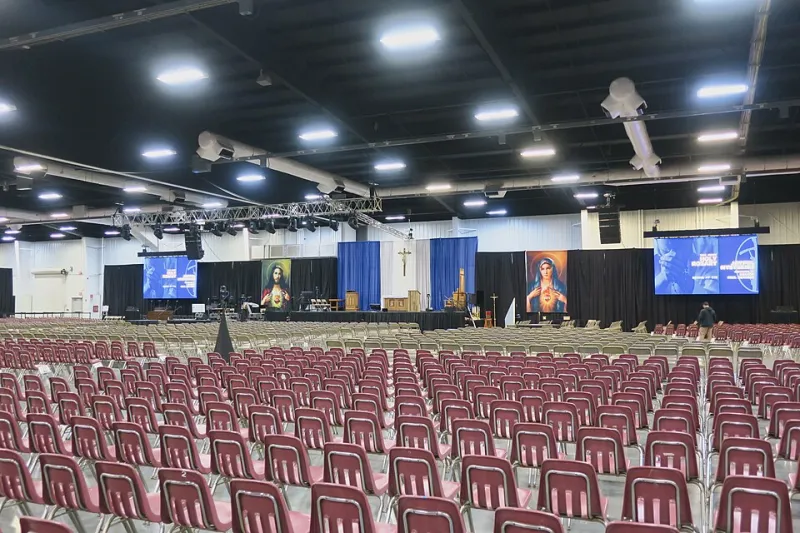
What the Empty Chair Said: Documenting Withdrawal and Silence in the Manchester 2013 Record

Photo: Crew crew, CC0, via Wikimedia Commons
The programme as a document of intention
A conference programme is a promise made in advance. It is drafted months before the event, negotiated between convenors, chairs and delegates, and printed or posted at a point when circumstances can still change. The Manchester 2013 programme is no exception. Read in 2026, it tells us a great deal about what the congress hoped to stage: which debates were considered live, which regions and subfields were represented, which convenors had succeeded in assembling a coherent panel. What it cannot tell us, on its own, is what actually took place in the rooms along the Oxford Road corridor that summer.
Between the printed page and the delivered paper lies a gap. That gap is not noise. It is part of the anthropological record, and it deserves the same editorial attention we give to abstracts, keynote transcripts and session reports.
Four kinds of absence
Not all absences are alike, and conflating them is the most common error made by readers of any conference archive.
Withdrawal before publication. Papers and panels removed during drafting appear nowhere in the final programme. Their absence is invisible unless earlier circulated drafts, call-for-papers correspondence or convenor reports survive. These are the hardest absences to recover and the easiest to over-interpret.
Late withdrawal. A speaker withdraws weeks or days beforehand; a replacement is found, or the slot is shortened, or a chair fills the time with extended discussion. Sometimes an erratum sheet is issued; often the change is announced verbally on the day. The programme then records an intention that was formally abandoned.
Non-delivery. The paper is listed, the room is booked, the chair arrives, and no speaker appears. There may be an apology read out, a note on the door, or nothing at all. This is the category most likely to be misread by later researchers as evidence about the scholar rather than about circumstance.
Structural absence. Proposed panels that never convened for want of submissions; sessions cancelled when a convenor fell ill; delegates who could not travel because a visa was refused, a grant was not paid, a flight was unaffordable or a caring responsibility could not be rearranged. These absences are produced by systems, not by individuals, and they are frequently the most revealing of all.
Silence has causes, rarely meanings
It is tempting to treat an undelivered paper as a judgement. It is not. The reasons recorded, where they are recorded at all, tend to be mundane and often private: illness, bereavement, a funding body declining to release a travel grant, a change in employment, a family emergency, a strike, a delayed visa, a cancelled flight. Some are matters of health data. Some are matters of institutional confidentiality. An archive that publishes them casually is not being thorough; it is being careless.
The responsible position is therefore modest. Record that a paper was not delivered; do not speculate about why. Where a reason is documented and non-sensitive, note it with its source. Where it is not, say so plainly. The neutral descriptor is ‘not delivered’ or ‘withdrawn’ — never ‘failed to attend’, which smuggles in an implication the record does not support.
Principles for a responsible reading
For scholars, seminar convenors and doctoral candidates working with the Manchester 2013 material in 2026, a short set of principles is worth keeping to hand.
- Give absence provenance. Every gap should carry a source and a date: a printed erratum, a convenor’s note, a post-congress report, an oral recollection, or an inference. Mark which.
- Distinguish documented from inferred. ‘Withdrawn according to the second erratum’ and ‘no evidence of delivery’ are different claims and should be footnoted differently.
- Do not cite an abstract as a delivered paper. Cite the abstract as an abstract, with a note on delivery status where known. The distinction matters for how a scholar’s trajectory is reconstructed.
- Treat timing as data. A withdrawal six months out and a withdrawal on the morning of the session tell very different stories about precarity, planning and institutional support.
- Flag reallocated slots. When a replacement paper was inserted, the intellectual content of that session changed. The archive should mark substituted contributions rather than silently merging them into the original listing.
- Notice the labour of repair. Chairs who extended discussion, discussants who improvised, and convenors who reorganised at short notice performed work the programme never credits.
- Aggregate before you generalise. Three absences prove nothing. A pattern across panels — a concentration among early-career scholars, or among delegates travelling from particular regions — is a finding worth reporting carefully.
Why the gaps matter for 2026
Disciplinary memory is built from records. If the Manchester 2013 archive reproduces only the programme as printed, it will reproduce the impression that everyone listed attended, that every panel ran to plan, and that the congress was a seamless field of speech. That impression has consequences. It flattens the unequal conditions under which international delegates travel. It hides the ordinary fragility of academic work. It also risks inflating the visibility of papers that were never heard, while undervaluing the informal discussion where much of the real intellectual work happened.
A map that conceals its blank spaces is a poor map. The archive’s task, in 2026 as in any year, is to draw the blanks in.
A practical note for users of the programme
Before quoting the Manchester 2013 programme as evidence of delivery, check the errata and the abstracts volume; look for post-congress reports in departmental newsletters and disciplinary bulletins; where possible, ask a surviving convenor or chair, and record their recollection as recollection. Then write the uncertainty into the footnote. A hedge is not a weakness in the record. It is the record being honest about itself.