Places at the Table: Manchester 2013’s Dinner Records and the Anatomy of Academic Belonging
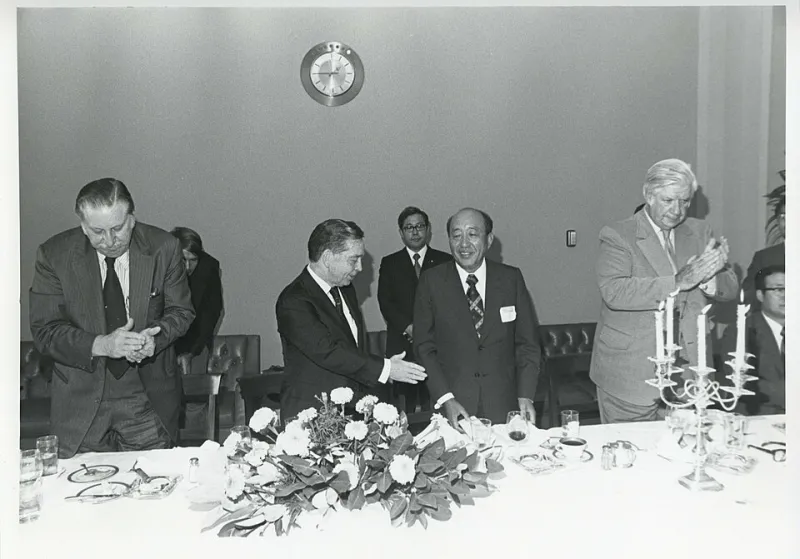
Photo: Carl Albert Research and Studies Center, Congressional Collection, CC BY-SA 4.0, via Wikimedia Commons
Conference archives tend to privilege the plenary, the panel and the printed abstract. The dinner is usually treated as atmosphere: a social interval after the serious business of anthropology. Yet the papers that survive from the Manchester 2013 conference dinner — menus, dietary requests, seating plans and catering notes — form an unexpectedly rich ethnographic record. They document hospitality as a set of decisions, and they show how inclusion is negotiated in the mundane machinery of an academic event.
For the IUAES 2013 Archive, these documents matter because they capture a part of the conference that the formal programme could not. A timetable can tell us who spoke. A dinner plan can tell us who was expected to sit with whom, which needs were anticipated, and which forms of participation were treated as optional. In 2026, as UK anthropology continues to debate access, belonging and the design of academic gatherings, the Manchester dinner record is less a curiosity than a practical case study.
The Dinner as a Document
The dinner archive is fragmentary, as all archives are. It includes menu drafts, catering correspondence, table plans and notes on dietary requirements. None of these items was produced as a scholarly statement. They were working documents, shaped by deadlines, budgets and the capacities of the venue. That is precisely what makes them useful. They record the assumptions that organisers made about delegates before anyone arrived.
A menu is not a neutral list. It indicates what kind of meal the organisers thought would be acceptable, affordable and impressive. It shows whether the event was designed around a formal served dinner, a buffet or a reception with standing space. Each format distributes access differently. A seated dinner creates clear places and clear exclusions. A buffet can be more flexible, but it can also make mobility, queueing and dietary separation harder to manage. The Manchester papers allow us to ask which model was chosen, and what that choice made possible for delegates with different needs.
Dietary Requests and the Limits of Hospitality
Dietary requests are often treated as a minor administrative category. In the archive, they are among the most revealing documents. They show that delegates were not abstract participants but people with religious observances, medical requirements, ethical commitments and cultural expectations. The wording of the request form matters: whether it invited detail, whether it offered only a tick-box, and whether it asked delegates to disclose information late in the process.
The catering notes also expose the gap between stated policy and practical delivery. A venue may agree in principle to provide vegan, halal, kosher, gluten-free or allergen-aware options, but the notes reveal whether those options were plated separately, labelled clearly or left to a delegate to negotiate at the table. In 2026, UK event organisers have better guidance on allergens and dietary inclusion than was common in 2013, but the underlying lesson remains: hospitality is only inclusive when it is planned into the menu, not added as an exception.
Seating, Hierarchy and the Informal Programme
The seating plan is perhaps the most anthropological document of all. It records proximity, and proximity is never neutral in an academic gathering. Who sat at the head table? Which institutions were clustered together? Were postgraduate researchers placed with senior scholars, or gathered at the back? Were international delegates distributed across tables, or did they form a separate group? Were there named places at all, or was seating left to self-organisation?
The Manchester record does not answer every such question, but it provides evidence for asking them. A formal top table can signal hierarchy and hospitality at once: it honours guests, but it also creates a visible centre. Open seating can feel democratic, yet it may reproduce existing networks, leaving newcomers to approach groups already formed during the day. The most inclusive design is rarely the absence of a plan. It is a plan that is deliberate about mixing, accessibility and the needs of people who find unstructured social occasions difficult.
Catering Notes and the Labour of Inclusion
The catering notes also draw attention to labour. Inclusive events do not organise themselves. They require someone to chase dietary requests, check labels, arrange accessible seating, brief venue staff and think about timing. This work is often invisible in the official record, and it is frequently done by administrators and early-career staff rather than by the scholars whose names appear on the programme. Reading the Manchester papers in 2026 should prompt a question about who carries this labour today, and whether it is recognised in event planning and workload models.
The notes also reveal the social assumptions built into a dinner. Evening events can exclude delegates with caring responsibilities, those who do not drink alcohol, those with mobility needs, and those who cannot afford an additional fee. A conference dinner may be optional in principle but socially central in practice. The archive invites organisers to ask whether a dinner is the only informal space on offer, and whether alternatives are given equal status.
Lessons for 2026 Event Design
For those designing academic events in 2026, the Manchester dinner record suggests several practical lessons. First, collect dietary and access requirements early, with free-text options and a clear statement of how information will be used. Second, do not treat dietary provision as a tick-box; check labelling, serving arrangements and staff briefing. Third, make seating intentional. If a formal plan is used, ensure it mixes institutions and career stages without forcing introductions. If seating is open, provide quiet tables and clear signals that newcomers are welcome.
Fourth, consider cost and time. A dinner that requires an extra fee, evening travel and formal dress will not be equally accessible to all delegates. Fifth, make alcohol-free hospitality visible and normal, not a separate concession. Sixth, recognise the administrative labour that makes inclusion possible, and resource it properly. Finally, archive the event’s own records. The Manchester dinner papers are valuable now because they survived. Future organisers should preserve menus, access notes and feedback so that the next generation of scholars can read inclusion as a practice rather than merely a principle.
A Table Worth Reading
The conference dinner is not a trivial appendix to the intellectual work of a conference. It is one of the places where academic culture is performed, negotiated and reproduced. Manchester 2013’s menus and seating plans allow us to see that performance in detail, with all its generosity and its gaps. In 2026, the task is not to judge the organisers of the past by the standards of the present, but to use their records to design better tables for the future.